

Every Saturday afternoon, I get to do something I have really enjoyed doing for the last sixteen years. Four years ago, my daughter and podcast co-host Tamanna joined me in this process. We did this in person for a couple of years, and then after she moved away for college, we started meeting on Zoom calls.
We pull up a list of insider purchases and sales for the week to identify a company or an insider we want to feature in the next edition of our Insider Weekends series. The back-and-forth as we debate whether an insider buy (or on rare occasions, a sale) is worth exploring in depth is particularly enriching.
But before we can start this little exercise, I aggregate and clean the data, then create the skeleton of what will become Sunday’s Insider Weekends article.
I briefly described part of this process in my article The $10 Billion Insider Purchase, where I wrote:
“There are a lot of weird things that happen with Form 4 filings and sometimes they are just outright wrong. Some companies realize their mistakes and file an amended Form 4 later, and some don’t. This is one of the reasons we clean the data before we calculate the Insider Sell/Buy Ratio every Saturday. We then read the footnotes of Form 4 filings before we pick companies that land on our list of top five insider purchases and sales in our weekly Insider Weekends articles.”
One week, when she had an exam or some other commitment, she asked me to take care of the entire process. Incidentally, that week we saw one of the largest open market insider purchases by an insider of Workday (WDAY), made by their new Co-CEO Carl Eschenbach.
Buy $2 Million in Stock, Get $5 Million in RSUs
Normally an insider purchase at a tech company, especially a $2 million open market purchase, would be interesting and could signal management’s confidence in the company. However, something about this purchase felt off to me, and that Sunday’s Insider Weekends article explored my hunch and how I found the money shot on page 4 of Carl Eschenbach’s employment agreement with Workday.
Here is what I wrote about that insider buy:
Additional Special RSUs: We finally get to the part of the employment agreement that explains the insider purchase. Mr. Eschenbach is entitled to another $5 million worth of RSU provided:
“you purchase shares of the Company’s common stock on the public market with a fair market value of Two Million Dollars ($2,000,000.00) within twelve (12) months following your Start Date”
And that is the money shot as to why he purchased shares on the open market. There are times when you can discover this kind of information by reading the footnotes of the form 4 filing but in this case, the footnotes of his form 4 filing did not specify this arrangement. It indicated that the stock was acquired through an established 10b5-1 plan and indirectly through a trust but made no reference to the “additional special RSUs”.
This is unlike the $5 million insider purchase by the new CEO of Pinterest (PINS) where his form 4 filing clearly specified the following in the first footnote:
“Purchased in connection with Mr. Ready’s employment agreement, pursuant to which the Company has agreed to grant Mr. Ready restricted shares of the Company’s Class A common stock following such purchase. The grant of such restricted shares has not yet been made.”
I would recommend checking out the employment agreement and the 8-K filed on December 20, 2022 for the various nuances tied to Mr. Eschenbach’s employment.
I’ve moved the full article outside our paywall and you can read it here.
Finding the Signal
This situation and the $10 billion insider purchase I alluded to in a different article illustrate why it is so hard to find actionable signals from the noise of insider data. In the early stages of their investing journey, folks often get excited by Peter Lynch’s oft-quoted observation:
“Insiders might sell their shares for any number of reasons, but they buy them for only one: they think the price will rise.”
While that statement had some foundation in truth when it was first written, the signal faded over time for several reasons:
You no longer have to physically send someone to the SEC in Washington DC to get this information. In my early days of exploring insider transactions, I used to look forward to reviewing them in the Value Line binders at my local library on Saturdays. Form 4s are now filed electronically and are readily accessible as soon as they are filed through numerous websites including the Insider Buying and Insider Sellingpages on InsideArbitrage.
Insiders are aware that investors like you and me are looking at this data, and at times might decide to buy stock to signal confidence even when the fundamentals of the company don’t warrant such optimism.
The sheer volume of insider transactions combined with a growing volume of mistakes in filings increases the noise in the raw data.
You have to discard purchases related to company-sponsored plans (director compensation, employee stock purchase plans, etc.), dividend reinvestment plans, or in unusual circumstances provisions in an insider’s employment agreement.
Over the years, we have written a lot of code to help us filter out some of the noise. The rest of the process is still manual and involves reading filing footnotes, looking at past transactions, understanding what is driving the company’s fundamentals and assessing how macro/industry trends are likely to impact the company.
50 Ideas a Year
We end up writing about fascinating companies, such as the one that emerged from Dr. Jennifer Doudna’s lab and uses a gene silencing technique to help the liver remove more LDL (bad) cholesterol from your blood. Or we might feature an organ transplant company that uses a new method to transport organs instead of the old process of sticking the organ in what is essentially an icebox. Sometimes we write about A Magic Mushroom Trip, and at other times, it is just about running shoes.
With about 50 ideas generated like this in a single year, not all of them are immediately actionable but they do generate a useful watchlist. We view these Insider Weekends articles as the starting point of our research. Occasionally we dive deeper into the idea as a spotlight idea in one of our monthly special situations newsletters. That organ transplant company ended up getting the deep dive treatment, was added to our model portfolio, and then purchased shares for my personal portfolio after the newsletter was published.
The Amrize Insider Purchases
Speaking of ideas that are not yet actionable, I am reminded of repeated insider purchases at a building materials company called Amrize (AMRZ).
Amrize was spun out of the Swiss company Holcim on June 20, 2025. Its shares began trading at around $51 per share on June 23 but trades for just $36.50 as of October 8, 2026. Along the way, and all the way down, all manner of insiders kept buying stock. CEO, Chief Legal Officer, CTO, Chief People Officer, Chief Strategy Officer. You name the executive, and they were all buying.
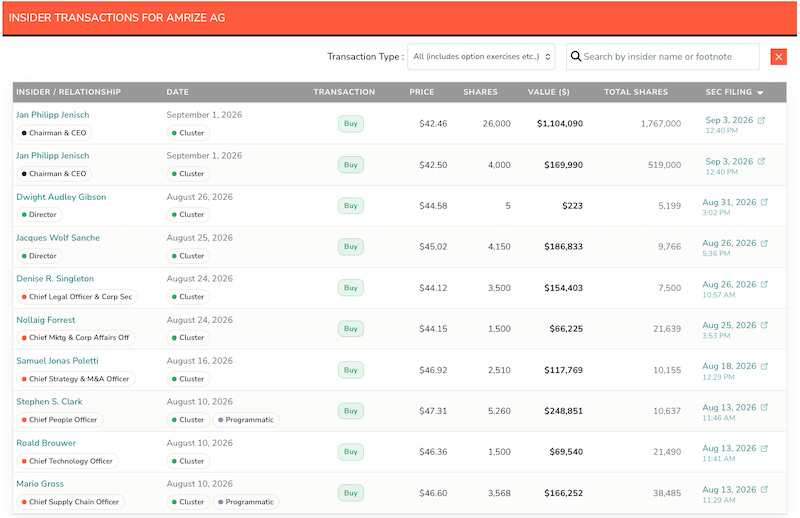
We covered the spinoff in our July 2025 Special Situations Newsletter and last month covered the cluster buying in an Insider Weekends article. But just like Carl Eschenbach’s purchase of Workday shares didn’t sit right with me, there was something about these Amrize purchases that kept troubling me.
Neither did the company fundamentals nor did the macro environment line up with the enthusiasm insiders were exhibiting. What was even more surprising was that they weren’t just buying token amounts. The CEO purchased more than $2 million worth of stock in May of this year and then followed it up with another $1.27 million worth of stock last month through open market purchases.
I was also intrigued by Amrize because the legendary investor Chris Hohn, of The Children’s Investment Fund Management (TCI), recently added two construction materials companies Vulcan Materials (VMC) and Martin Marietta Materials (MLM) to TCI’s portfolio. These investments seemed uncharacteristic compared with some of TCI’s other major holdings like Visa (V), Moody’s (MCO) and Alphabet (GOOG).
Companies like Amrize, Vulcan Materials and Martin Marietta supply “aggregates”, such as crushed stones, sand and gravel as well as other construction materials like limestone, cement and concrete. Their quarries are often located close to major urban centers. Transporting heavy materials over long distances can be prohibitively expensive, creating local monopolies for nearly quarries. You can start to understand why Sir Christopher Hohn is interested in these companies.
However, the potential motivation for the Amrize insider purchases turned out to be even more interesting than Chris Hohn’s investment thesis for buying similar companies. As you can see from page 69 of the company’s proxy statement, insiders are required to own a certain amount of stock. The CEO must own shares worth 10 times his base salary, directors must own five times their cash retainer and other executives must own three times their salary. These ownership guidelines could help explain the persistent insider buying.
Once I discovered these ownership requirements, my interest in Amrize fell a little. However I was glad I got to learn about its business and that knowledge helped me appreciate TCI’s decision to add Vulcan Materials (VMC) and Martin Marietta Materials (MLM) to its portfolio.
Conclusion
We follow eight different strategies at InsideArbitrage and the magic starts to happen when we start to see the same names show up across these strategies (for example the spinoff of Amrize, followed by insider buying). This broad net helps us catch fish we might not otherwise see.
My favorite among these strategies remains insider purchases because of the sheer volume of new ideas it generates for us every week. Both the model portfolio and my personal portfolio have benefited from this discovery process.
Voluntary Disclosure: I hold long positions in Workday (WDAY), On Holding (ONON) and Transmedics (TMDX) as well as every stock in the model portfolio except for one.
Disclaimer: Please do your own due diligence before buying or selling any securities mentioned in this article. We do not warrant the completeness or accuracy of the content or data provided in this article.