

Before I get into my latest article, I wanted to share a quick announcement about a webinar our intern Luke Hammerschmidt is doing next Wednesday at 1 PM ET regarding his research related to C-Suite transitions with a specific focus on CEO and CFO changes.
You can check out the webinar and sign up for it here.

I was recently reading a quarterly letter by Chris Pavese of Broyhill Asset Management and he included the following quote by Ernest Hemingway:
“There is nothing to writing. All you do is sit down at a typewriter and bleed.”
The “bleed” part of the quote reminded me of George Bernard Shaw and the children’s book author Roald Dahl who would step out into a small hut separate from their primary homes to write. This is a technique my daughter also uses as she moves to a separate physical location to focus on writing some of our Insider Weekends articles.
Chris went on to say the following in his letter:
“Writing has always been a valuable tool for me, both personally and professionally. It has never been a particularly easy or enjoyable process, but the result usually justifies the effort. Through writing, I am able to flesh out my thinking, find holes in my logic, and distinguish highly confident ideas from those held more loosely.”
Chris’ admission that writing is neither easy nor enjoyable reflects what George Orwell wrote towards the end of his essay Why I Write, where he said:
“Writing a book is a horrible, exhausting struggle, like a long bout of some painful illness. One would never undertake such a thing if one were not driven on by some demon whom one can neither resist or understand.”
I have been writing publicly for twenty years and while the process is hard (I had to go to a separate physical space for three months to write most of my book), I actually find it immensely useful. In an AI era where productivity is greatly improved and the first thing most people outsource to AI is writing, I would propose that it should be an activity you continue to personally persevere in.
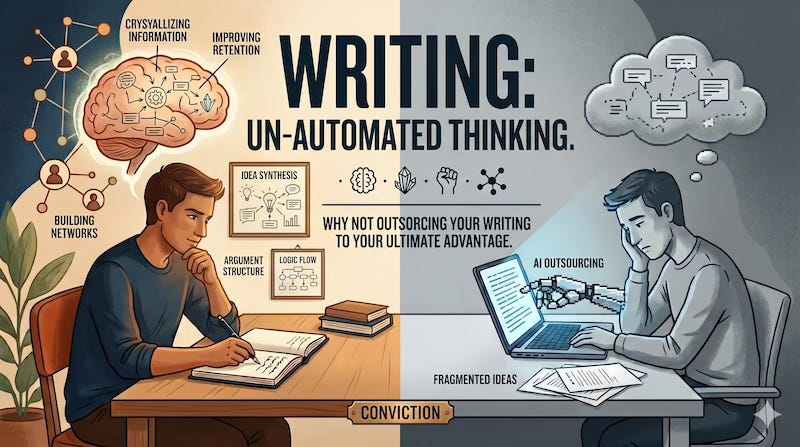
The five reasons I continue to write are:
Writing as meditation: I have tried to meditate numerous times, both with the use of apps (Calm, Headspace, etc.) and without them, but have had very little success with it. The more I thought about it, the more I realized that in many ways writing is my meditation. It requires several hours of focus on a single topic and you often achieve flow state. The creative process gets the neurons firing but it is also calming.
Writing improves retention: In a world where we are constantly inundated with new information and the signal-to-noise ratio is slowly eroding, we are in many ways training our brains to continually discard information and retain very little. I find that writing significantly enhances my memory of the topic or company I am writing about. A precursor to writing is research, and you often spend as much time, if not more, on the research before you start writing. This one-two punch of research and writing is likely solidifying the memory pathways in my brain and helping with retention.
Writing crystallizes information: This is a benefit that writers often bring up, just as Chris did in his letter. I have found that at times I start writing with a certain idea in mind but by the end of the process I have changed my mind and reached a very different conclusion. This is particularly useful in investment research, where you really need to flesh out your assumptions and reasoning before you decide whether to invest in an opportunity and how to size the position.
Writing increases conviction: Buying an investment is just one part of the process. You also need to know when to hold for the long run and when to sell. Holding on to an investment when things appear to be going against you requires conviction. One way to build that conviction is to write about the investment before you buy it, and share that research with others. I have often gone back to read my own reports to either build conviction or determine if the latest development is something that invalidates the original thesis, and requires a change. The change could be related to:
selling the investment
buying more of it (as a rule I don’t double down on investments but allow for very rare exceptions) or
improving your investment process to help you anticipate something like this new development in the future
Writing as a networking tool: Sharing your research broadly whether it is through your own site like I do on InsideArbitrage or through various social media platforms will help you connect with other investors who might have a common interest. Better yet, you might hear from someone who might have an opposing view. Writing in public and the critical feedback I received in my early years were fundamental to my development as an investor, especially as someone coming in from outside this world and without a mentor. Beyond that, writing also helped me:
land a book deal from Harriman House (now Pan MacMillan)
create lasting friendships with folks I often meet in person
start two businesses
launch a podcast
Is There a Role for AI?
I am not a luddite or AI denier. In fact, I have built software systems from the ground up for enterprise clients and implemented ERP or EHR solutions in a past life.
We use AI extensively at InsideArbitrage both to ingest data and help us ramp up rapidly on new companies or industries that our event-driven processes unearth. We have developed detailed prompts that help us with the research process. In some instances, data ingestion times have gone down by more than 50%, allowing us to do more.
Productivity on the programming side has improved even more dramatically with our programmers writing very little code. They are now mostly focused on orchestration, verification, testing, and deployment. We have a slew of features and enhancements we are currently working on that we hope to roll out in the coming weeks.
The temptation to hand over the reins to AI is strong but when it comes to writing and certain other tasks, I believe it is still best to exercise human ingenuity and not let our creative muscles atrophy. The most I do with AI for writing is run the article through my favorite LLM with the prompt “check this article for spelling, grammar, and clarity issues” and ask Gemini to generate an image for the article.
The hardest part for me, unlike other writers, is getting started and knowing when to end. The middle part, thankfully, takes care of itself. Towards that end, I hope this article encourages you to continue writing if you have already been battling this demon or to get started if you have been contemplating it.